
Defense & Aerospace Laser Solutions for Mission-Critical Applications:

Rugged Lasers Delivering Precision & Reliability in Harsh Environments

battlefield with setting sun, four soldiers marching and a helicopter hovering in the center - defense & military laser applications

    • RPMC favicon Field-Proven Ruggedness – Built to perform in harsh environments, designed to withstand shock, vibration, thermal extremes, and humidity
    • RPMC favicon Low SWaP Optimization – Compact, lightweight designs that fit handheld, vehicle-mounted, UAV, and airborne platforms, maintaining performance
    • RPMC favicon “Eye-Safe” & Tactical Wavelengths – 1.5 µm and SWIR options for safety and clear atmospheric transmission + UV-LWIR for specialized applications
  • RPMC favicon Thousands of Units Fielded – Proven track record in DoD programs, with qualifiable solutions, backed by full support throughout the process

30 Years Enabling Critical Programs for Defense & Aerospace with Field-Proven Laser Sources

Show me Defense & Aerospace Laser Sources!

Tackle your defense challenges with RPMC’s expertise & mission-ready lasers:

Navigating the Toughest Defense & Aerospace Laser Challenges

Six-month schedule slip on a custom module? Beam dies at 40°C? RPMC can help:

simple line graphic of a target and a lightning bolt representing pain points

  • ITAR & Export Nightmares
    Sensitive data, endless paperwork & disappearing vendors when compliance questions arise, causing delays
  • Schedule-Killing Lead Times
    Big suppliers quote 18-24 months for “Custom” – program office needs hardware for the approaching PDR
  • ‘Impossible’ Low SWaP Specs
    Ex: High pulse energy at ‘eye-safe’ 1.5µm in a robust, compact package w/ extended operating temp. range
  • Qualification Hell
    Meeting MIL-STD-810H, STANAG, EMI & more – maintaining peak performance in harsh conditions
  • Spec Creep & Big Company Bureaucracy
    Requirements change every review cycle – large laser companies may ignore unless it’s a massive order

We get your pain – we work with the same primes and agencies you do. RPMC delivers battle-tested, U.S.-supported solutions with the flexibility larger firms often lack: rapid prototypes, configurable & fully tailored solutions, and direct access to the manufacturer’s engineering team.

Tell us about YOUR challenges – we’ve likely solved something similar already:

Explore real-world Success Stories:

How RPMC’s lasers support critical missions in the field

Real-World Success:
Laser Solutions for Defense & Aerospace Applications

With 30 years of experience, RPMC supports defense primes, integrators, and program managers – from DoD agencies to Tier-1 contractors – with rugged, qualifiable laser solutions built for your toughest missions. We collaborate closely with you and our engineers, from choosing eye-safe wavelengths to customizing for low SWaP, shock/vibration, or extreme thermal conditions. We prioritize maintaining your tight timelines, controlling costs, and ensuring high reliability, providing proven laser sources that perform in real operations. With thousands of units fielded in rangefinders, DIRCM, HEL demonstrators, and FSOC systems across North American programs, our flexibility, end-to-end support, direct manufacturer access, and rapid response times help turn RFPs into successfully deployed systems.

Here’s how our lasers have supported programs like yours in the field:

Defense & Aerospace Success Stories

“Eye-Safe” 1550 nm Emitters Strengthen Long-Range Ranging Performance
brass colored to-56 laser diode package, circular with 3 electrical pins and a tall silver cap with optical window

Programs upgrading their rangefinding or precision-guidance modules often struggle to achieve higher ‘eye-safe’ peak power and stronger return signals than 905 nm diodes can provide. After discussing their performance and SWaP constraints with RPMC’s technical team, system designers evaluated triple-junction 1550 nm pulsed diodes, offering higher efficiency and improved return strength in haze, dust, and maritime environments. This allows extended detection ranges and better accuracy, with greatly increased output power and only a minimal increase in power consumption or thermal load.

Laser Solution: High peak power, “eye-safe” 1550 nm multi-junction pulsed diode for LRF/targeting/guidance systems

Outcome: Stronger return signals in degraded visibility and extended effective operating range within existing SWaP constraints

1550 nm SOAs Boost Link Margin for Free-Space Optical Communication
14-pin butterfly fiber-coupled semiconductor optical amplifer SOA package

LEO constellation designers required reliable free-space optical communication to support high-throughput, low-latency links between satellites. Their challenge was achieving sufficient optical gain and modulation bandwidth in a compact, radiation-resilient package. After evaluating link budget requirements with RPMC’s technical experts, they adopted high-gain 1550 nm semiconductor optical amplifiers, which provide strong single-mode amplification and high saturation power for robust inter-satellite links.

Laser Solution: Compact, high saturation power, high-gain single-mode 1550 nm SOA for FSOC sat comms

Outcome: Reliable, high-speed optical links with enhanced resistance to interception, improving overall constellation connectivity

Compact 1550 nm Pulsed Fiber Lasers Improve Autonomous Space Navigation
BK-FL-Pulsed: 1 or 1.5µm Pulsed Fiber Lasers

CubeSat and small-sat programs increasingly rely on pulsed LIDAR for proximity awareness and debris avoidance, but most commercial lasers are too large or thermally unstable for tight spaceborne SWaP constraints. By defining their pulse-energy, packaging, and vacuum constraints in collaboration with RPMC’s team, they identified a 1550 nm nanosecond pulsed fiber laser that offered stable, eye-safe output in a compact hermetic design suited for LEO thermal cycling.

Laser Solution: Compact, high-power, 1.5 µm nanosecond pulsed fiber laser, hermetic design for small-sat missions

Outcome: Accurate telemetry and obstacle detection to support safer autonomous CubeSat navigation

High-Energy 532 nm Pulses Improve Airborne Mapping Stability
Aero: High-Energy DPSS Nanosecond/Picosecond Laser

Teams developing next-generation LIDAR mapping payloads needed a compact, rugged 532 nm source that maintained pulse energy and stability through vibration, temperature swings, and high-altitude duty cycles. Their previous laser drifted thermally and produced inconsistent returns over water and vegetation. By reviewing the requirements with RPMC’s team, they identified a nanosecond 532 nm DPSS platform, such as our Aero Series of high-energy lasers, delivering the stable pule-to-pulse energy needed for reliable multi-return bathymetry and terrain profiling.

Laser Solution: High-energy, conduction-cooled, nanosecond pulsed 532 nm DPSS laser for airborne sensing

Outcome: More consistent foliage and water returns, improved waveform stability, and reliable data quality under representative flight conditions

Mid-IR QCLs Enable More Compact Infrared Countermeasure Development
UniMir: 10-17um: DFB Narrow Linewidth Gas Sensing QCL

Developers of IR countermeasures and seeker-testing equipment needed to replace bulky lamp or OPO sources that limited modulation speed and introduced SWaP challenges. After reviewing wavelength, modulation, and thermal constraints with RPMC’s specialists, they transitioned to compact mid-IR quantum cascade lasers, providing >1 W average output per chip and fast modulation capabilities in a small HHL package. This enabled lighter, more agile countermeasure prototypes and simplified thermal and mechanical design.

Laser Solution: Compact, high-power, fast-modulating mid-IR QCLs for IRCM/DIRCM development

Outcome: Reduced system size, thermal requirements, and improved waveform agility for modern mid-IR countermeasure testing & simulation

SWIR Illumination Enhances Identification with Modern InGaAs Sensors

Teams modernizing their low-light imaging suites needed a SWIR illuminator that matched the sensitivity of new InGaAs cameras while reducing signature in the visible and near-IR bands. Older illuminators often produced bloom, spectral leakage, or insufficient irradiance at operational ranges. Working with RPMC to refine their illumination and spectral requirements, they selected high-power SWIR multimode diodes, available in free-space and fiber-coupled formats in the LDX-SWIR series, providing compact, spectrally aligned output for long-range contrast and recognition.

Laser Solution: Compact, high-power & brightness, SWIR CW laser diode for covert illumination and long-range imaging

Outcome: Improved identification performance with modern SWIR sensors and reduced visibility to legacy NIR/visible detectors

RPMC has provided laser sources for many successful Defense & Aerospace projects:

RPMC’s success is driven by our dedicated team & the invaluable support of our skilled & innovative manufacturers.

Explore our wide range of laser technology, powering those Defense & Aerospace successes:


Key Laser Products for Your Mission-Critical Needs


RPMC’s battle-tested portfolio of precision lasers drives your next program milestone – from handheld targeting pods to orbital HEL demonstrators – ensuring reliable performance in extreme environments where failure isn’t an option.

Our ruggedized lineup spans “eye-safe” multimode diodes to multi-kW fiber systems, pump modules, wavelength combiners, and compact amplifiers, all engineered for seamless integration into your tactical platform, airborne system, or secure comms terminal.

Dive into the defense laser groups below, each tied to core defense & aerospace applications, with built-to-spec options for wavelength, pulse energy, beam quality, and low SWaP optimization – locked in to meet your RFP requirements down to the last MIL-STD.


Application Group Application Supporting Laser Categories
Remote Sensing & Imaging
  • Bathymetry
  • Laser Radar
  • LIDAR
  • 3D Scanning
  • Remote Threat Detection
Space-Based Applications
  • Space Laser Communications
  • Airborne/Space LIDAR
  • Space Sensing
  • Space-Based High-Energy Lasers (HEL)
  • Space-Based Beam Control/Steering
Targeting & Ranging
  • Laser Range Finders
  • Laser Targeting Systems
  • Laser Guidance Systems
  • Directed Energy Weapons (DEW)
  • High-Energy Laser (HEL) Weapons
  • Tactical Laser Systems
Laser Illuminators
  • Night Vision
  • Laser Dazzlers
  • Anti-Sensor
Laser Communication & Data Links
  • Free-Space Optical Communication (FSOC)
  • Laser Communications
  • Secure Data Transmission

Custom Defense & Aerospace Laser Solutions:

Wafers to Components, Modules, Prototypes & Ruggedized Systems

Despite providing > 10,000 standard SKUs, your next program milestone often requires a built-to-spec solution. Our world-class partners will collaborate with you to define specifications and help you get the exact laser source your project requires, customized for the rigorous demands of your mission profile.

Tailored Laser Solutions for:

•  “Eye-Safe” Rangefinding & Precision Designation  •  Directed Energy & HEL Weapon Systems  •  DIRCM & IRCM Countermeasures  •  Free-Space Optical Comms & Secure Links  •  Airborne LIDAR & Bathymetric Mapping  •  Tactical Dazzlers & Anti-Sensor Blinding  •  Space-Based Sensing & Beam Steering  •  Laser Guidance & Threat Detection  •
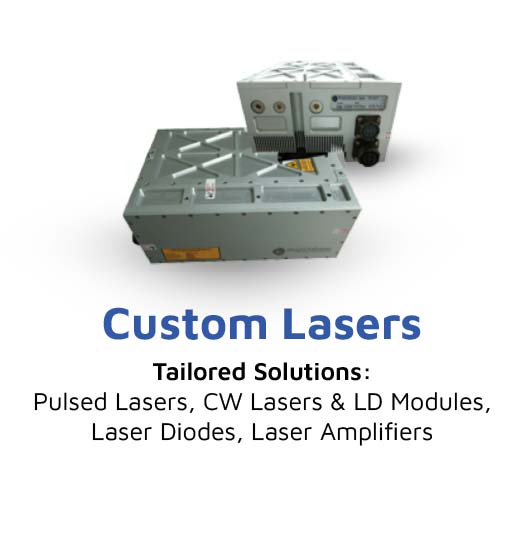
custom lasers and text illustrating our ability to fully customize a laser solution

Learn More About RPMC’s Customization Capabilities

See why integrators trust RPMC for their next program win:


RPMC is a Leading Supplier for Your
Defense & Aerospace Laser Solutions


RPMC at a Glance:

  • RPMC favicon 30 years serving defense programs
    RPMC favicon 10,000+ standard laser configurations
    RPMC favicon 1000s of units fielded in N. America
    RPMC favicon Battle-tested laser sources
    RPMC favicon Built-to-spec customization options
    RPMC favicon Personalized, direct technical support
    RPMC favicon Flexible & agile – minimal bureaucracy
    RPMC favicon US-origin & MIL-Spec options
    RPMC favicon Buffer stock for program surges
    RPMC favicon On-time deliveries amid tight schedules

    “RPMC delivered the rugged laser we needed to hit our milestone on time – zero failures in quality testing!”

    ~YOUR Name Here (IF you Contact Us!)


Small Enough to Care, Big Enough to Deliver

For over 30 years, RPMC has powered everything from tactical rangefinders to space-based HEL systems for North America’s leading primes, integrators, and government agencies. Our defense-experienced team, backed by top-tier manufacturer partners, guides you from wavelength selection to full SWaP-C optimization, with modular laser solutions that integrate seamlessly into your platform or prototype.

We tackle common defense hurdles, providing rugged, configurable lasers that meet your cost targets, engineered with the exact specs for extreme performance, reliability, and compliance – no matter the mission profile.

As a responsive, agile U.S. small business, we offer expert guidance, rapid quotes for RFPs, and direct access to factory engineers for streamlined collaboration, helping you navigate spec creep, export controls, and long cycles to keep your programs on track.

RPMC is your trusted laser partner for mission overmatch.
Learn More About Defense & Aerospace Lasers: Blogs & FAQs

Component FAQs

Can I operate multiple laser diodes from the same power supply?

Can I operate multiple laser diodes from the same power supply?

The same power supply can drive multiple laser diodes if they are connected in series, but they must never be connected in parallel. When two diodes are connected in series, they will function properly as long as the compliance voltage is large enough to cover the voltage drop across each diode. For example, suppose you are trying to power two diode lasers, each with an operating voltage of 1.9 V, and connect the two in series. In that case, the pulsed or CW laser driver must have a total voltage capacity greater than 3.8 V. This configuration works because diodes share the same current when connected in series. In contrast, when two diodes are connected in parallel, the current is no longer shared between the two diodes. Get more details on the topic in this article: “Can I Operate Multiple Laser Diodes From the Same Power Supply?” Get more information from our Lasers 101, Blogs, Whitepapers, FAQs, and Press Release pages in our Knowledge Center!

Can laser diodes emit green, blue, or UV light?

Can laser diodes emit green, blue, or UV light?

The output wavelength of a semiconductor laser is based on the difference in energy between the valance and conduction bands of the material (bandgap energy). Since the energy of a photon is inversely proportional to its wavelength, this means that a larger bandgap energy will result in a shorter emission wavelength. Due to the relatively wide bandgap energy of 3.4 eV, gallium nitride (GaN) is ideal for the production of semiconductor optoelectronic devices, producing blue wavelength light without the need for nonlinear crystal harmonic generation. Since the mid-’90s, GaN substrates have been the common material utilized for blue LEDs. In recent years, GaN based laser technology has provided blue, green and UV laser diodes, now available in wavelengths from 375 nm to 521 nm, with output powers exceeding 100 watts. Read our article, titled “Gallium Nitride (GaN) Laser Diodes: Green, Blue, and UV Wavelengths” to learn more about GaN Based Laser Diodes, available through RPMC. Get more information from our Lasers 101, Blogs, Whitepapers, and FAQs pages in our Knowledge Center!

How long will a laser diode last?

Honestly, it depends on several factors, and there is no simple chart to cover everything. Typical diode lifetimes are in the range of 25,000 to 50,000 hours. Though, there are lifetime ratings outside this range, depending on the configuration. Furthermore, there are a wide range of degradation sources that contribute to a shorter lifespan of laser diodes. These degradation sources include dislocations that affect the inner region, metal diffusion and alloy reactions that affect the electrode, solder instability (reaction and migration) that affect the bonding parts, separation of metals in the heatsink bond, and defects in buried heterostructure devices. Read more about diode lifetime and contributing factors in this article: “Understanding Laser Diode Lifetime.” Get more information from our Lasers 101, Blogs, Whitepapers, FAQs, and Press Release pages in our Knowledge Center!

What factors affect the lifetime of laser diodes?

There are a great many factors that can increase or decrease the lifetime of a laser diode. One of the main considerations is thermal management. Mounting or heatsinking of the package is of tremendous importance because operating temperature strongly influences lifetime and performance. Other factors to consider include electrostatic discharge (ESD), voltage and current spikes, back reflections, flammable materials, noxious substances, outgassing materials (even thermal compounds), electrical connections, soldering method and fumes, and environmental considerations including ambient temperature, and contamination from humidity and dust. Read more about these critical considerations and contributing factors in this article: “How to Improve Laser Diode Lifetime: Advice and Precautions on Mounting.” Get more information from our Lasers 101, Blogs, Whitepapers, FAQs, and Press Release pages in our Knowledge Center!

What is a laser diode?

A Laser Diode or semiconductor laser is the simplest form of Solid-State Laser. Laser diodes are commonly referred to as edge emitting laser diodes because the laser light is emitted from the edge of the substrate. The light emitting region of the laser diode is commonly called the emitter. The emitter size and the number of emitters determine output power and beam quality of a laser diode. Electrically speaking, a laser diode is a PIN diode. The intrinsic (I) region is the active region of the laser diode. The N and P regions provide the active region with the carriers (electrons and holes). Initially, research on laser diodes was carried out using P-N diodes. However, all modern laser diodes utilize the double-hetero-structure implementation. This design confines the carriers and photons, allowing a maximization of recombination and light generation. If you want to start reading more about laser diodes, try this whitepaper “How to Improve Laser Diode Lifetime.” If you want to read more about the Laser Diode Types we offer, check out the Overview of Laser Diodes section on our Lasers 101 Page!

What is the difference between laser diodes and VCSELs?

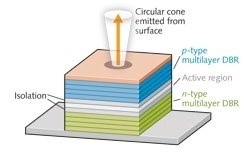
Laser Diodes and VCSELs are semiconductor lasers,  the simplest form of Solid State Lasers.  Laser diodes are commonly referred to as edge emitting laser diodes because the laser light is emitted from the edge of the substrate. The light emitting region of the laser diode is commonly called the emitter.  The emitter size and the quantity of emitters determine output power and beam quality of a laser diode. These Fabry Perot Diode Lasers with a single emission region (Emitter) are typically called laser diode chips, while a linear array of emitters is called laser diode bars. Laser diode bars typically use multimode emitters, the number of emitters per substrate can vary from 5 emitters to 100 emitters. VCSELs (Vertical Cavity Surface Emitting Laser) emit light perpendicular to the mounting surface as opposed to parallel like edge emitting laser diodes.  VCSELs offer a uniform spatial illumination in a circular illumination pattern with low speckle. If you want to read more about lasers in general, and help narrowing down the selection to find the right laser for you, check out our Knowledge Center for our Blogs, Whitepapers, and FAQ pages, as well as our Lasers 101 Page!VCSEL

What’s the difference between single transverse mode & single longitudinal mode?

What’s the difference between single transverse mode & single longitudinal mode?

Within the laser community, one of the most overused and often miscommunicated terms is the phrase “single mode.”  This is because a laser beam when traveling through air takes up a three-dimensional volume in space similar to that of a cylinder; and just as with a cylinder, a laser beam can be divided into independent coordinates each with their own mode structure.  For a cylinder we would call these the length and the cross-section, but as shown in the figure below for a laser beam, we define these as the transverse electromagnetic (TEM) plane and the longitudinal axis.   Both sets of modes are fundamental to the laser beam’s properties, since the TEM modes determine the spatial distribution of the laser beams intensity, and the longitudinal modes determine the spectral properties of the laser.  As a result, when a laser is described as being “single-mode” first you need to make sure that you truly understand which mode is being referred to.  Meaning that you must know if the laser is single transverse mode, single longitudinal mode, or both. Get all the information you need in this article: “What is Single Longitudinal Mode?” Get more information from our Lasers 101, Blogs, Whitepapers, FAQs, and Press Release pages in our Knowledge Center!

Pulsed Lasers FAQs

What is a Pulsed Laser?

A pulsed laser is any laser that does not emit a continuous-wave (CW) laser beam. Instead, they emit light pulses at some duration with some period of ‘off’ time between pulses and a frequency measured in cycles per second (Hz). There are several different methods for pulse generation, including passive and active q-switching and mode-locking. Pulsed lasers store energy and release it in these pulses or energy packets. This pulsing can be very beneficial, for example, when machining certain materials or features. The pulse can rapidly deliver the stored energy, with downtime in between, preventing too much heat from building up in the material. If you would like to read more about q-switches and the pros and cons of passive vs active q-switches, check out this blog “The Advantages and Disadvantages of Passive vs Active Q-Switching,” or check out our Overview of Pulsed Lasers section on our Lasers 101 Page!

What is the best laser for LIDAR?

What is the best laser for LIDAR?

There are actually numerous laser types that work well for various LIDAR and 3D Scanning applications. The answer comes down to what you want to measure or map. If your target is stationary, and distance is the only necessary measurement, short-pulsed lasers, with pulse durations of a few nanoseconds (even <1ns) and high pulse energy are what you’re looking for. This is also accurate for 3D scanning applications (given a stationary, albeit a much closer target), but select applications can also benefit from frequency-modulated, single-frequency (narrow-linewidth) fiber lasers. If your target is moving, and speed is the critical measurement, you need a single-frequency laser to ensure accurate measurement of the Doppler shift. If you want to learn more about the various forms of LIDAR and the critical laser source requirements, check out our LIDAR page for a list of detailed articles, as well as all the LIDAR laser source products we offer. Get more information from our Lasers 101, Blogs, Whitepapers, FAQs, and Press Release pages in our Knowledge Center!

What is the best laser for tattoo removal?

What is the best laser for tattoo removal?

The best laser for tattoo removal depends on factors like wavelength versatility, pulse duration, and energy output to effectively target various ink colors while minimizing skin damage. Q-switched or ultrafast lasers with pulse durations of 100 ps to 10 ns and a fluence of ~10 J/cm² are ideal for fragmenting ink via selective photothermolysis. For example, the Lampo 266-1064 nm offers multiple wavelengths (266 nm, 532 nm, 1064 nm) for multi-color tattoos, while the Nimbus 770-1064 nm provides customizable sub-nanosecond pulses for precision. The Quantas-Q1 delivers high pulse energy (up to 32 mJ at 1064 nm) for efficient treatments.

For more details on pulsed lasers for tattoo removal applications, see our blog, “Choosing the Right Laser for Tattoo Removal: Key Considerations‘! Get more information from our Lasers 101, Blogs, Whitepapers, and FAQ pages in our Knowledge Center!

We’re here to offer expert advice & to you help select the right laser for your application.
Contact Us Here or email us at info@rpmclasers.com!

What is the difference between active and passive q-switching?

There are a wide variety of q-switch technologies, but the technique as a whole can be broken down into two primary categories of q-switches, passive and active. Active q-switches could be a mechanical shutter device, an optical chopper wheel, or spinning mirror / prism inside the optical cavity, relying on a controllable, user set on/off ability. Passive q-switches use a saturable absorber, which can be a crystal (typically Cr:YAG), a passive semiconductor, or a special dye, and automatically produce pulses based on it’s design. Both passive and active q-switching techniques produce short pulses and high peak powers, but they each have their pros and cons. When choosing between actively q-switched and passively q-switched lasers, the key is to understand the tradeoffs between cost/size and triggering/energy and decide which is best for your particular application. Read more about these tradeoffs in this article: “The Advantages and Disadvantages of Passive vs Active Q-Switching.” Get more information from our Lasers 101, Blogs, Whitepapers, FAQs, and Press Release pages in our Knowledge Center!

What type of laser is used for LIBS?

A laser source used for LIBS must have a sufficiently large energy density to ablate the sample in as short a time possible. Typically, pulsed DPSS lasers take center stage here. However, it’s been shown that pulsed fiber lasers can also be a great option. For example, you could utilize fiber lasers to measure detection limits as low as micrograms per gram (µg/g) for many common metals and alloys, including aluminum, lithium, magnesium, and beryllium. Analytical performances showed to be, in some cases, close to those obtainable with a traditional high-energy Nd:YAG laser. The beam quality of fiber lasers, in conjunction with longer pulse widths, resulted in significantly deeper and cleaner ablation craters. If you want to learn more about LIBS and ideal laser sources, check out either this blog: “OEM Fiber Lasers for Industrial Laser Induced Breakdown Spectroscopy,” or this blog: “Laser Induced Breakdown Spectroscopy (LIBS) in Biomedical Applications.” Get more information from our Lasers 101, Blogs, Whitepapers, FAQs, and Press Release pages in our Knowledge Center!

Which IR laser is best for laser target designation?

There are many different types of laser designation systems used by the military today. Still, they all share the same basic functionality and outcome. At a glance, the laser requirements seem relatively straightforward. The laser needs to be invisible to the human eye, and it needs to have a programmable pulse rate. Still, when you look in more detail, many small factors add up to big problems if not appropriately addressed. Excellent divergence and beam pointing stability, low timing jitter, and rugged, low SWaP design are all critical features of a good laser designation source. Read more on these critical features in this article: “What are the Critical Laser Source Requirements for Laser Designation?” Get more information from our Lasers 101, Blogs, Whitepapers, FAQs, and Press Release pages in our Knowledge Center!

CW Lasers FAQs

How do I align my optical system?

How do I align my optical system?

Laser alignment can be a challenging task, but aligning a laser beam doesn’t have to be as complicated as it might seem with the right optical alignment tools and proper laser alignment techniques. Multiple optical alignment techniques have been developed over the years, utilized by technicians and engineers to simplify the alignment process. With the development of these universal laser beam alignment methods, along with some laser alignment tips and tricks, you don’t need to be a laser expert to perform your alignments with relative ease, ensuring your laser beam path is right where you want it to be and your beam is on target every time. Read our article, titled “Laser Alignment: HeNe Lasers, Methods, and Helpful Tips” to get the knowledge and advice you need for proper optical beam path alignment utilizing HeNe Lasers. Get more information from our Lasers 101, Blogs, Whitepapers, FAQs, and Press Release pages in our Knowledge Center!

Should I choose multimode or single-mode for Raman spectroscopy?

On the surface, this seems like a simple question since Raman is a nonlinear optical effect and therefore the tighter the beam can be focused the higher the conversion efficiency.  Seemingly a single-mode laser would be preferable, but in practice there are other factors that can complicate the situation. The first question you should ask yourself when considering which type of laser to choose is whether you are doing microscopy or bulk sampling.  If the answer to that question is microscopy, then you immediately should go with a single mode laser.  Since the goal of any microscopy system is to produce the highest resolution image possible, the number one consideration should be how tightly can the laser beam be focused down. However, there are several other considerations when choosing between multimode and single-mode. Learn which is best for you in this article: “Multimode vs Single-Mode Lasers for Raman Spectroscopy.” Get more information from our Lasers 101, Blogs, Whitepapers, FAQs, and Press Release pages in our Knowledge Center!

What is a CW Laser?
What is a CW Laser?

A CW or continuous-wave laser is any laser with a continuous flow of pump energy. It emits a constant stream of radiation, as opposed to a q-switched or mode-locked pulsed laser with a pulsed output beam. A laser is typically defined as having a pulse width greater than 250 ms. The first CW laser was a helium-neon (HeNe) gas laser, developed in 1960, which you can read more about in this blog “HeNe Lasers: Bright Past, Brighter Future.” If you want to read more about the types of CW Lasers we offer, check out the Overview of CW Lasers section on our Lasers 101 Page!

What is the best laser for optical surface flatness testing?

It is essential that the laser exhibit a high level of spectral stability, ensuring that any changes in the interference pattern are caused by features in the sample and not originating from the laser beam. In addition to spectral stability, high beam pointing stability ensures consistent measurements by mitigating any beam position drift concerning the position of the sample. Lasers with longer coherence lengths, and subsequently narrower linewidths, play an important role in determining the resolution of the measurement, as well as consideration of the wavelength used. Exhibiting both single longitudinal mode and single spatial mode has excellent benefits. Get more information from our Lasers 101, Blogs, Whitepapers, FAQs, and Press Release pages in our Knowledge Center!

What type of laser is best for Doppler LIDAR?

What type of laser is best for Doppler LIDAR?

Various LIDAR signal methods for measuring velocity have one critical requirement in common, the need for precise control over laser frequency. While a wide variety of single-frequency lasers have been used in Doppler LIDAR research, the industry as a whole has adopted single-frequency fiber lasers as the ideal light source. Fiber lasers have several advantages over traditional DPSS lasers, all of which derive from the geometry of the fiber optic itself, namely the innate ability to have an extremely long single-mode optical cavity. This geometry allows for the production of either extremely high-power, single-mode lasers producing unprecedented brightness, or extremely narrow band lasers, with near perfect single-frequency output. If you want to learn more about Doppler LIDAR, the critical considerations involved, and ideal laser sources, check out this whitepaper: “Single-Frequency Fiber Lasers for Doppler LIDAR.” Get more information from our Lasers 101, Blogs, Whitepapers, FAQs, and Press Release pages in our Knowledge Center!

What’s the difference between single transverse mode & single longitudinal mode?

What’s the difference between single transverse mode & single longitudinal mode?

Within the laser community, one of the most overused and often miscommunicated terms is the phrase “single mode.”  This is because a laser beam when traveling through air takes up a three-dimensional volume in space similar to that of a cylinder; and just as with a cylinder, a laser beam can be divided into independent coordinates each with their own mode structure.  For a cylinder we would call these the length and the cross-section, but as shown in the figure below for a laser beam, we define these as the transverse electromagnetic (TEM) plane and the longitudinal axis.   Both sets of modes are fundamental to the laser beam’s properties, since the TEM modes determine the spatial distribution of the laser beams intensity, and the longitudinal modes determine the spectral properties of the laser.  As a result, when a laser is described as being “single-mode” first you need to make sure that you truly understand which mode is being referred to.  Meaning that you must know if the laser is single transverse mode, single longitudinal mode, or both. Get all the information you need in this article: “What is Single Longitudinal Mode?” Get more information from our Lasers 101, Blogs, Whitepapers, FAQs, and Press Release pages in our Knowledge Center!