
 BUY NOW
Mid-IR (MWIR) molecular spectroscopy is a rapidly developing and promising technique, enabling high-performance chemical detection and analysis for industrial or environmental purposes, with new wavelength ranges becoming commercially available. The essential component for such applications is the laser source, adapted to the specific spectral lines (the fingerprint) of the target molecule. Quantum Cascade Lasers (QCLs) are a perfectly suited solution to build such analysis systems. Until now, QCLs only covered the wavelength range from 4 to 10µm, where many chemical species are detected (NO, N2O, NH3, CH4, COH2, CO, CO2, SO3, etc.). However, the fingerprint region extends much farther in the infrared, and current laser technologies don’t allow for the analysis of many molecules of interest.
Among these molecules of interest are an important class, aromatics (benzene, toluene, ethylbenzene, and xylenes, known as BTEX), which have their main fingerprint absorption lines at wavelengths ranging from 12µm to 15µm. BTEX are toxic, volatile, organic compounds that are principally emitted by the petrochemical industry. Benzene is naturally present in crude oil. It is used primarily as a precursor to manufacture chemicals with a more complex structure, widely used in the chemical industry. Benzene and toluene are used as additives in gasoline and are often detected at filling stations, a significant source of exposure for humans. BTEX molecules are also frequently produced and released in the atmosphere during large fires or industrial accidents. The detection of BTEX is then a major issue for environmental monitoring and safety.
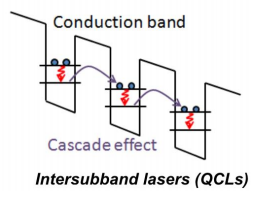 A new class of Distributed Feedback (DFB) QCLs has been developed at the University of Montpellier, France, in a joint laboratory with CNRS. The unique aspect is the use of different III-V semiconductor materials to fabricate the active region of the lasers. These materials are part of the antimonide family, a specialty of the University of Montpellier for decades. The foundation of QCLs consists of artificial heterostructure alternating nanometer-scale quantum wells and barrier layers. While the standard QCL uses InGaAs and AlInAs on an InP substrate – the basis of the optoelectronics telecom industry – this novel QCL technology is based on InAs and AlSb. These materials’ specific properties enabled the expansion of QCL wavelength range from 2.6µm to 25µm [1, 2]. High-performance laser sources have been demonstrated recently in the range 10 to 20µm [3-5], with powers in the milliwatts range emitted at room temperature in a continuous wave. An efficient DFB process was also demonstrated for the fabrication of single-frequency tunable lasers suitable for spectroscopy applications [6]
 Tunable diode laser absorption spectroscopy (TDLAS) with temperature tuning (λ ≈ 14.9µ)
 mirSense is a well-known and established entity, with 20 years of expertise in the MWIR-LWIR QCL wavelength range for defense and spectroscopy and now offers this new InAs-based QCL technology. Their groundbreaking UniMir line of long-wavelength, single-frequency DFB QCLs are now commercially available in a sealed High Heat Load (HHL) package, with integrated collimating lens, thermistor, and thermoelectric cooler (TEC). The UniMir is well suited for integration into systems, or as a stand-alone turnkey system for R&D and detection applications. These lasers, operated in CW or in pulsed mode, emit a maximum power of 5 to 10mW (<15µm) at room temperature. By controlling the chip’s operating temperature through the Peltier element inside the laser’s package, customers tune the emission wavelength without mode hopping, while maintaining single longitudinal mode operation. The technology’s versatility allows them to address any wavelength between 10 and 18µm in CW and up to 21µm in pulsed mode, opening the way for high-resolution spectroscopy applications in this spectral range, notably for the detection of BTEX, but also CH3I, HCN and many other molecules. Compared to wavelengths produced by previous QCL technology, these new QCLs will enable much stronger absorption rates by these molecules, with less cross interference from other molecules in the 10m-17µm range.
 Showing the difference in energy gap among the various QCL substrate materials
Below we’ve listed a couple of example configurations and their target application:

Benzene:
Perfect for benzene environmental monitoring, this ~14.9µm (~674 cm-1) UniMir model is a single-mode DFB QCL, operating in CW mode with 5mW output power (with the base plate of the HHL-package at +20oC). The full tunable range is >2cm-1, while the continuous tuning range, free from ‘mode hopping’ is >0.5cm-1.
 |
 |
 |
The curves on the left indicate the voltage of the laser as a function of the applied DC current and laser chip temperature. The curves on the right indicate the output power as a function of the applied DC current and laser chip temperature | |
The curves indicate the typical laser single-mode emission wavelength as a function of the applied DC current and laser chip temperature. Lasers with slightly shifted wavelength are also available. | |
Xylene and Propane:
Perfect for xylene and propane monitoring in the chemical industry, this ~13.4µm (~746 cm-1) UniMir model is a single-mode DFB QCL, operating in CW mode with 5mW output power (with the base plate of the HHL-package at +20oC). The full tunable range is ~3cm-1, while the continuous tuning range, free from ‘mode hopping’ is >1cm-1.
 |
 |
|
The curves indicate the voltage (left) and output power (right) of the laser as a function of the applied DC current and laser chip temperature. | |
Emission spectra as a function of the temp. of the laser chip. | |
To get more details and technical information on these groundbreaking new Quantum Cascade Lasers from mirSense, Click Here!
Talk to one of our knowledgeable Product Managers today by emailing us at info@rpmclasers.com or Contact Us with the button below!
Have questions?

mirSense came into being in 2015 after years of developing the QCL technology. They design and manufacture high-power (typically watt-level) diodes in 4.0µm, 4.6µm, 4.8µm, and 9.Xµm wavelengths, and now offer mW level DFB QCLs from 10µm through 17µm. They’re able to handle anything from small scale development to mass production runs due to their trusted relationship with a local supplier, industrial oriented manufacturing methods, and agile supply chain. Utilizing their highly skilled team of Ph.D. engineers and proprietary, innovative solutions, based on a robust patent portfolio, mirSense brings solutions to customers all over the world. |
 |